Branding
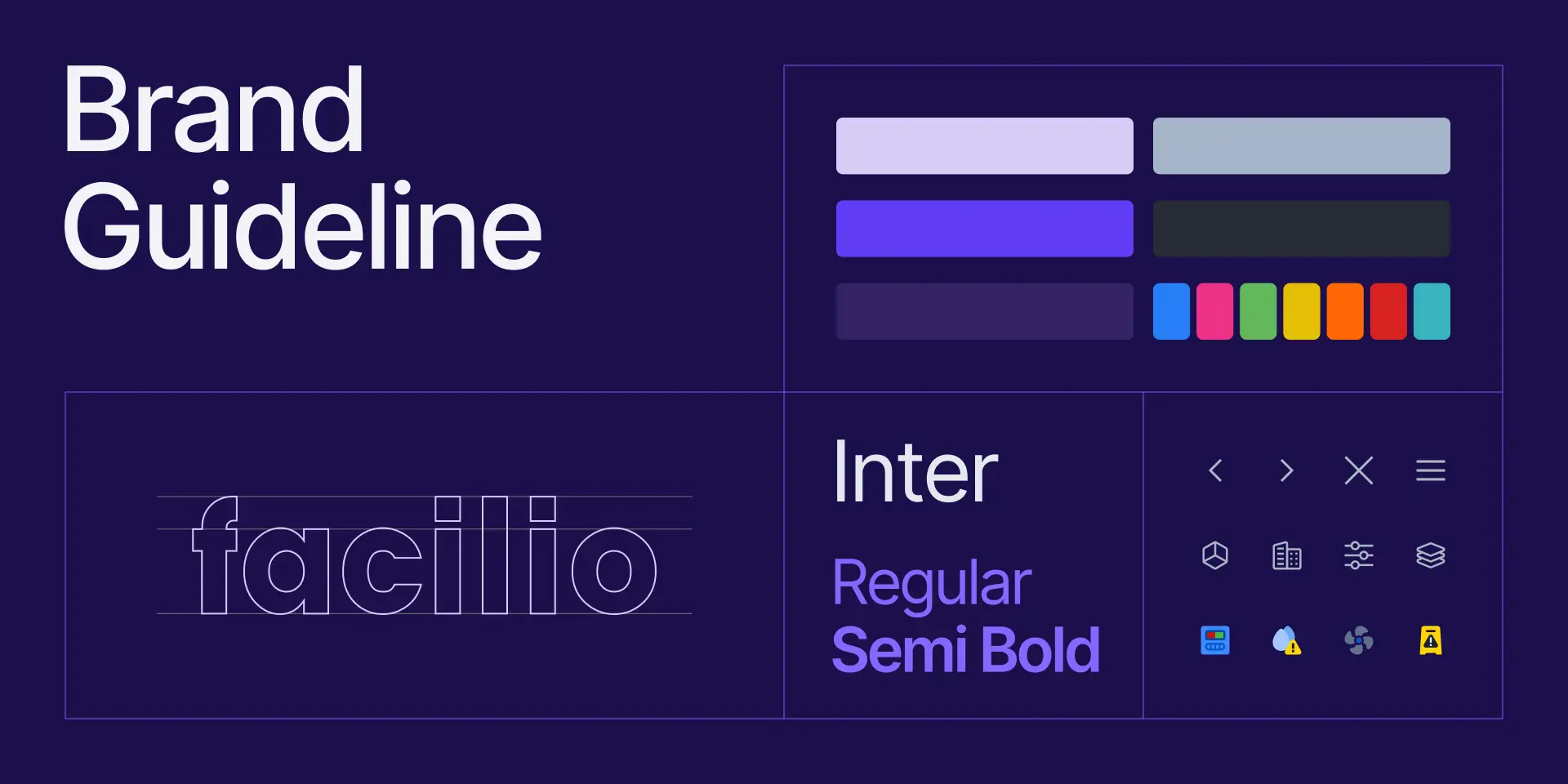
Description
When I joined Facilio, the company was scaling rapidly across marketing, product, and sales. However, there was no centralized brand guideline in place. Visual outputs varied across teams, marketing assets lacked consistency, and design decisions were often subjective.
To solve this, I led the creation of Facilio’s first comprehensive Brand Guideline, a scalable framework that aligned design, marketing, and business goals under one cohesive visual language.
My Role
Visual Designer
Guideline Owner
Challenge
Facilio had strong business momentum but lacked visual governance.
Key Problem
No defined brand system or rulebook
Inconsistent logo usage and color application
Marketing assets designed ad-hoc
Designers and marketers working without a shared visual framework
Excessive iteration cycles due to subjective feedback
Time lost in alignment discussions
Why a Brand Guideline Was Necessary
Ensure visual consistency across global touchpoints
Scale marketing production efficiently
Reduce dependency on design for small decisions
Improve brand recall and trust
Align visual communication with business positioning (Smart Buildings / Enterprise SaaS)
The goal wasn’t just aesthetics — it was operational clarity.
Process
I approached this as a structured brand system initiative — not a visual refresh. The objective was to create a scalable foundation that aligned product, marketing, and leadership under a unified visual language.
Brand Audit & Strategic Alignment
I began by auditing all existing touchpoints — website, pitch decks, performance ads, social media creatives, sales PDFs, and product UI. The audit revealed inconsistencies in typography usage, color application, iconography styles, and logo treatments.
Alongside the audit, I studied competitors in the Smart Buildings and Enterprise SaaS space to understand positioning gaps. I worked closely with leadership to define Facilio’s intended brand personality — enterprise-grade, forward-looking, and solution-oriented.
Key Focus
Identify inconsistencies
Benchmark competitors
Align brand with business positioning
Brand Foundations
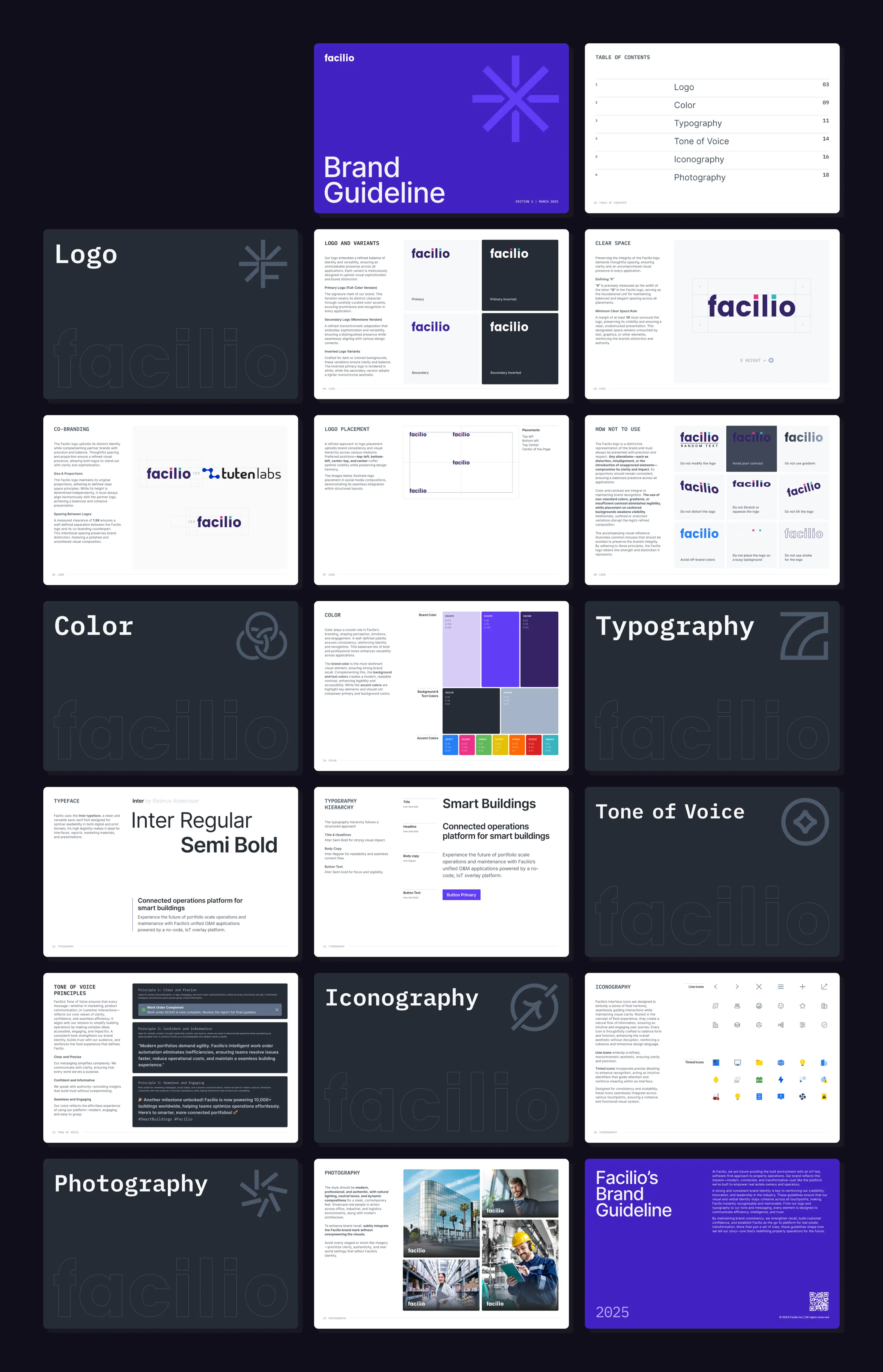
I established a structured logo system including primary, secondary, and inverted variations. Clear space rules, minimum sizing, incorrect usage examples, and co-branding guidelines were documented to eliminate ambiguity.
This ensured brand integrity across partnerships and global campaigns.
Color System
Facilio’s core identity revolved around its distinctive purple gradient. I expanded this into a structured system:
Primary – Brand-defining purple gradient
Secondary – Supporting tonal variations
Accent – Controlled highlight colors
Functional / Alert – UI-specific feedback colors
This framework unified product UI and marketing assets under one cohesive palette while maintaining functional clarity.
Typography System
I standardized the typography using Inter (Regular & Semi Bold) to ensure clarity, scalability, and digital compatibility.
The system defined:
Heading hierarchy
Body text scale
Button and UI usage
Marketing vs Product typography behavior
This created visual harmony between product interfaces and brand communication materials.
Iconography & Visual Language
To remove stylistic inconsistencies, I defined a clear icon framework — consistent stroke weight, grid alignment, and usage rules for filled vs outline styles.
Illustrations and visual accents were standardized to ensure both marketing and product teams used the same visual language.
The result was a cohesive system rather than disconnected visual elements.
Tone of Voice
To reflect Facilio’s enterprise positioning, I defined messaging principles centered around:
Clear
Confident
Solution-driven
Future-focused
These principles helped marketing communicate complex building operations technology in a simple and authoritative manner.
Photography Direction
Photography guidelines emphasized:
Smart building environments
Real facility operators
Technology in action
Authentic imagery over generic stock
This strengthened credibility and aligned visuals with the product’s real-world impact.
Documentation & Rollout
The final system was consolidated into a structured brand guideline deck and shared across design and marketing teams.
I conducted stakeholder walkthroughs to ensure adoption and empowered teams to self-serve brand decisions — reducing dependency on constant design validation.
Design Process
Outcome
Strengthened enterprise brand perception, contributing to more cohesive global communication and improved stakeholder confidence.
Improved brand consistency by 90% across marketing and product touchpoints, establishing a unified and scalable visual system.